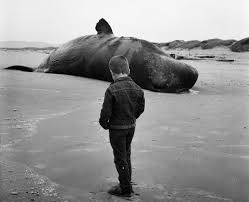
Whales have a tendency to explode after they die. As their innards rot, methane builds up in air pockets and it can reach surprisingly high pressures. Eventually, without warning – kaboom.
In 2004, bystanders in Taiwan experienced this for themselves when scientists attempted to move a dead whale through the streets. Around 600 people were sprayed with blood and entrails when the carcass ruptured mid-transport. Less a scientific exercise, more an unintended public spectacle.
There are, it turns out, established ways of dealing with this. One is to cut into the whale and release the pressure gradually. Another is controlled demolition – breaking the whale into smaller parts so that decomposition can happen more predictably.
But perhaps the most famous example of what not to do comes from Florence, Oregon, in 1970. Faced with a 45-foot whale on the beach, authorities reached for dynamite. Not a little dynamite – 20 cases of it. The assumption seemed to be that a whale was essentially a large rock. The result was catastrophic. Chunks of blubber rained down over a wide area, damaging cars and leaving debris hanging from trees for weeks.
According to one expert afterwards, they probably needed about 20 sticks, not 20 cases.
The problem wasn’t the dynamite. It was the model. Someone looked at a complex, organic system and decided it could be treated like inert matter. The response followed from that misdiagnosis.
And this is where it becomes uncomfortably familiar.
Professional development in education often follows a similar pattern. Pressure builds slowly – in classrooms, in departments, in the daily complexity of teaching. Workload, curriculum change, gaps in subject knowledge, shifting expectations. None of it dramatic on its own, but collectively it accumulates.
Then, eventually, we act.
But instead of carefully releasing that pressure – through subject-specific dialogue, through co-planning, through precise and contextualised support – we reach for something bigger. A whole-school INSET. A generic framework. A strategy designed to fix everything at once.
And like the Oregon whale, the results are rarely contained.
Initiatives scatter. Staff are overwhelmed. Implementation becomes compliance. The original problem is not so much solved as redistributed, often landing somewhere else in the system.
What sits behind this is a deeper issue. We still lack a clear way of thinking about how teachers learn. We borrow from pedagogy, we borrow from andragogy, but neither quite fits. Teachers are not novices, nor are they simply generic adult learners. They are professionals working in complex, subject-specific contexts.
This is where the idea of didagogy, as proposed by the Teacher Development Trust, becomes useful. It offers a way of conceptualising professional learning as something distinct: not the delivery of content, but the careful design of conditions in which teachers can refine, adapt and develop their practice.
Seen through that lens, the lesson of the whale is straightforward.
Effective professional learning is not about force. It is about precision.
It is about knowing where the pressure is, understanding its source, and responding in ways that are proportionate and grounded in context. Sometimes that means small, deliberate interventions. Sometimes it means creating space for collaboration. Often it means doing less, but doing it better.
Because when we misjudge the problem, we don’t just fail to solve it.
We risk making a much bigger mess.

