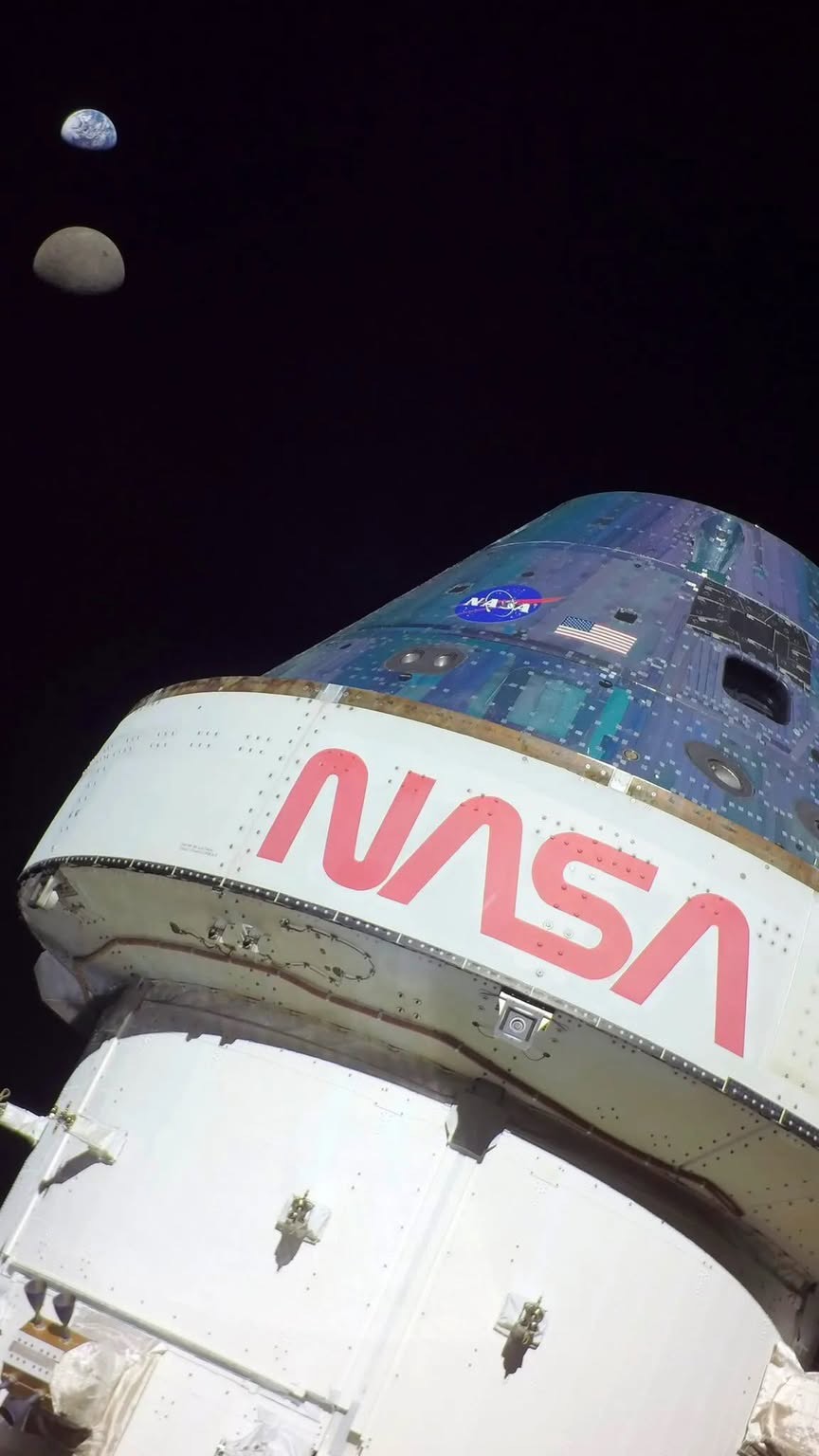
“I saw the crescent, you saw the whole of the moon”. The Waterboys
I have been in awe this week. The images and reporting of the Artemis II have been a welcome and perhaps much needed relief from news of mounting tension and conflict on Earth. And yet, it is often in these moments that a sociological perspective helps us make sense of what we are really looking at.
I have been in awe at the rockets, the satellites, the idea that we are still capable of being a species that looks up and beyond itself.
But alongside this technological triumph, I am left with feelings of uneasiness. The race to the moon is not just about the march of progress, it echoes familiar geo-political concerns and questions the political and economic drivers of this enterprise. Space exploration has never been a neutral act and the sky is not an empty space.
There are now over 14,000 satellites orbiting Earth, with tens of thousands more planned, alongside debris, pollution, and even proposals to light up the night sky itself. So what is going on here and how might students of sociology use their sociological imagination to explore this new moon race?
Functionalism: progress… or dysfunction?
From a functionalist perspective, this all makes sense. The function of space exploration is to bind societies together. It inspires. It drives innovation. It gives us GPS, weather prediction, global communication. Societies need collective goals and space exploration is a classic tool of Durkheim’s concept of social solidarity where we can feel united in a common endeavour. Sat around our televisions, watching the amazing footage, feeling the same feels.
But here’s the tension: when does function become dysfunction? When the same system that gives us communication satellites also creates great risks for our world including orbital congestion, pollution in the stratosphere, and the risk of cascading collisions that could make space unusable. Are we watching a system overshoot its limits?
Marxism: whose space is it anyway?
I guess the question for sociologists to ask is who gets the profit and who carries the risk?
The space race has never just been about science. It has always been about power. However, this time it may not be Cold War nationalism but it is about platform capitalism, competition between billionaires and the exclusive rights to resource extraction, lunar mining, mega-satellites and data centres in orbit. Sci-Fi movies just got real.
Marxists would argue this is a classic example of enclosure where a common good is turned into commodity. Space as the next frontier of capitalism where the costs (pollution in the upper atmosphere, risks to global infrastructure) are borne but us all but the profits in the hands of private individuals.
Feminism: who is missing?
The Artemis II mission with Christina Koch on board has rightly been celebrated. A woman on a high-profile lunar mission matters. Representation and role models matter. But feminist sociology would not stop at celebration. It would ask more uncomfortable questions. Does one high-profile woman change the structure of space science. Is this transformation at scale or does it risk becoming tokenistic, what some might call “add women and stir”?
Feminist writers like Sandra Harding have long argued that science is not neutral, it has been historically shaped by masculine values. Harding reminds us that representation is not the same as transformation.
The deeper question is whether space exploration itself is still the epitome of malestream science. The language of “missions”, “command”, “race” is still rooted in what has been called the male stream of science: control, conquest, technical mastery.
Who gets to go to the moon matters, but who decides what we do when we get there matters more. Whose knowledge counts? Whose priorities shape the mission? And who is still missing?
Because without changing the underlying values, we risk celebrating inclusion into a system that looks similar to the familiar male-dominated scientific paradigms of competitive and driven by the same power relationships.
Whose voices shape the future of space? Feminist writers would highlight the gendered nature of the narratives that emerge: hero astronauts, tech billionaires, national prestige. Where are the values of care, sustainability, cooperation? Who is asking not just whether we can colonise space but whether we should and on what terms and at what cost to human and non-human life back on earth?
Interactionism: how do we make sense of the sky?
On a micro level, something more subtle and nuanced is happening. Our interactions with the space missions have radically altered the meaning of space to us. The sky was once the place of myths, gods and heavens above. And who cannot gaze upon the pale blue dot without being mesmerised by its fragility and wonder. However, our scientific endeavours have introduced a new lens through which we understand space. The moon has become infrastructure, a network and a market-place. These subtle shifts have the meanings of space in our everyday interactions. What happens if we no longer look up in awe but replace that with the algorithm
Postmodernism: simulation, spectacle, and space
From a postmodern lens, someone like Jean Baudrillard would probably see the Artemis II not simply as a journey to the moon, but as an exercise in hyperreality where the representation of the mission becomes more real, more meaningful, than the mission itself.
Artemis II has not been the grainy uncertainty of the 1960s; it has been experienced through a media-saturated world livestreams, twitter-feeds, cinematic visuals, branded rockets, floating corporate logos are all instantly consumed.
In this sense, we are not just watching space exploration, in our interactive commentaries, we are all participating in a simulation of it, where meaning is generated through media. The moon is a backdrop to the real spectacle, the story we tell about human destiny takes centre stage.
For Baudrillard, this is a hyperreal space race. Are we exploring space or performing exploration?
So what?
The sociological imagination forces us to try to make sense of social phenomena beyond their manifest meanings, to connect biography and history. It is clear that our fascination with space is not just scientific curiosity but has also been shaped by capitalism, politics and culture.
By reaching for the moon, are we really moving forward or simply repeating the same mistakes, just a little higher up?
 the unconscious curriculum