I watched the excellent BBC documentary Inside the Rage Machine last week and it has taken me a while to reflect on it. It was an excellent documentary and whilst it did not reveal something new it has forced me forced me to confront something I’ve probably chosen to ignore.
Social Media is not a mirror to or of society. It is something far more insidious and pervasive than that.
Some people might argue that social media simply reflects existing social divisions and that the anger, the mistrust, the polarisation were there already. And, it is true social divisions existed before social media. But what the documentary lays bare is how these platforms do not just reflect reality they also reshape, amplify and distort it beyond all recognition. We sleep walked into an attention arms race.
The social media platforms are not competing to inform us, or entertain us, they are competing to hold us worse than any episode of Charlie Brooker’s Black Mirror. Every scroll, swipe, pause, moment of outrage is captured, quantified and fed back into the algorithm designed to keep us there just a little longer. It is the shock and anger that keep us there.
The social media firms know that negative, emotionally charged, and toxic content performs better, travels further. It demands engagement and provokes reaction. And so the system adapts and learns from these reactions.
There is no surprised that the comment sections of Facebook reels and TikTok feeds are dominated by hostility. Outrage works, borderline content that comes close to the edges of acceptability without quite breaching the rules is king.
The documentary clearly demonstrates this how this dynamic has played out in the real world. From the violence in Sri Lanka and Myanmar, to the Covid riots in Rotterdam, to unrest closer in Southport. In each case, the pattern is the same: misinformation spreads rapidly, takes root, and mutates forming falsehoods upon falsehood, reinforcing anger at every turn. This is not news, but the economic imperative for the social media giants was difficult to ignore.
These are publicly traded companies. Engagement drives revenue. Revenue drives share price. When performance dips, there is a clear incentive for them to tweak the algorithm to maximise attention. There is a choice to be made here, the social media giants could choose an algorithm that promotes well-being but this is much less profitable. Provocation pays well.
The documentary also highlights a deeper structural issue within these companies. There is a kind of digital Fordism, where the people building the algorithms are often separate from those responsible for trust and safety. One team optimises engagement and another tries to manage the consequences.
The result is predictable and by the time harmful content is addressed, it has already spread and achieved its goal. This has been exacerbated by the purchase of X by Elon Musk in 2022, who dismantled much of the safety mechanisms and reinstated banned accounts. The consequences of this are clear to anyone who still visits the bin fire that is X with the normalisation of more extreme content.
TikTok intimately knows us and our scrolling habits. It tracks how long we linger, what we skip, what we return to. The feed is beyond our control, curated with precision and it learns what content holds your attention. Even if you tell the platform you are not interested in violent content, it reappears later on.
For teenagers still forming their sense of the world, this is significant. If your feed is saturated with anger, grievance, and conspiracy, that becomes your reality, a visceral feeling that the world is against you. It is difficult for adults to know the boundaries between truth and distortion, what chance does a teenager have?
The Southport case, referenced in the documentary, is a chilling example. False information circulates rapidly, unchecked, anger builds, scapegoats are identified and action follows. Each share, each comment, each reaction adds fuel. This is not accidental, it is designed this way.
These platforms have not simply lost control, the checks and balances are weak and power is now concentrated in the hands of a small number of tech billionaires. This leaves us with a democratic deficit, no single individual should have the ability to shape the information ecosystem on such a grand scale.
Algorithms are no longer just organising content, they are shaping our perceptions, our politics and people. The rage isn’t accidental. It’s engineered. And unless we are willing to regulate it and talk honestly about it, it will only get worse. The solution has to be better regulation and education as well as a debate about the pace of this social change. The rage and anger is built into the algorithms that are set to maximise engagement and profit at any cost, and that cannot be right.
BBC Inside the Rage Machine
https://www.bbc.co.uk/iplayer/episodes/m002sw4z/inside-the-rage-machine
Congratulations to Marianna Spring, this was a thought-provoking documentary and supported with the OU resources below.
https://connect.open.ac.uk/ragemachine/#videos
The OU site helpfully has this page which helps us begin the debate about what next.
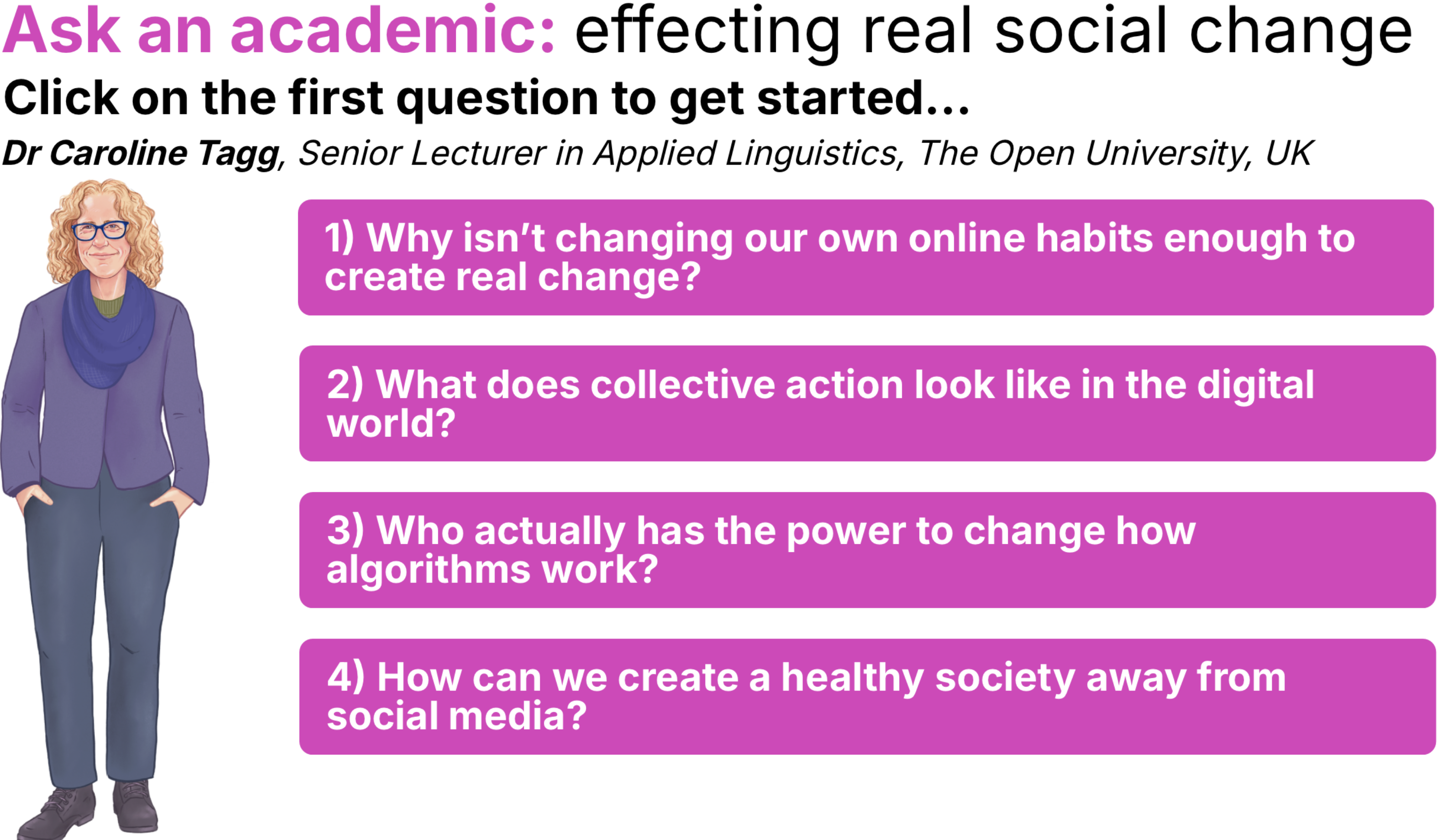
Ask an academic: effecting real social change
Click on the first question to get started…
Dr Caroline Tagg, Senior Lecturer in Applied Linguistics, The Open University, UK
Why isn’t changing our own online habits enough to create real change?
Individuals can effect real change, particularly over our own behaviour. We don’t have to scroll through mindless content. We could put our phones down and go outside. But relying on individuals to change their own online habits is not the only solution. It’s like local volunteers rallying around to clean up beaches after shipping container spills – it’s worth doing but it doesn’t tackle the bigger problem. Trying to change individual online habits can deflect blame from the social media companies who invest huge amounts of money and resources to keep us on their apps, and it stops us from collectively imagining a better future.
What does collective action look like in the digital world?
What we need is a new, positive and inclusive vision of what social media and the internet can be. There are numerous examples of sites, apps and grassroots actions that challenge the dominance and ethos of social media – from the old-school forum Reddit and the open source social networking platform Mastodon, to neighbourhood WhatsApp groups and women-only ridesharing apps.
Networks and charities such as the Electronic Frontier Alliance and the Good Things Foundation fight for a fairer digital future. But it is doubtful that such initiatives can seriously challenge the billionaire tech bros’ hold over the internet.
Who actually has the power to change how algorithms work?
Social media companies won’t choose to go against their financial interests by adjusting their algorithms. Governments need to work with tech leaders to legislate change that works towards a better version of the internet.
In the UK, for example, policies such as the Online Safety Act 2023 and government guidance on banning mobile phones in schools, alongside expanding global cooperation such as the UN Convention against Cybercrime, reveal our political leaders’ awareness of the need to act. But a focus on bans and preventing harm only gets us so far.
How can we create a healthy society away from social media?
People cannot simply be pushed off social media – they must be pulled towards something that they enjoy doing more than being on social media. Community groups, third-sector organisations and local councils can enhance local facilities and social activities for young and old alike, supported by governmental funding. The National Trust, for example, is working to widen access to the UK’s diverse cultural and natural heritage, including slow looking experiences with their art – promoted, of course, through their social media feeds. Social media is at its best when people use it to facilitate and enhance their offline lives, putting physical connections and spaces first. This is where we as individuals have a role to play – we can help to create a better digital world by using our phones to connect with others in our neighbourhoods and find local community initiatives.
 the unconscious curriculum